This post may contain affiliate links, which means I’ll receive a commission if you purchase through my link, at no extra cost to you. Please read full disclosure here.
The Goldfinch will give your book club so much material to discuss that you won’t possibly be able to cover it all.
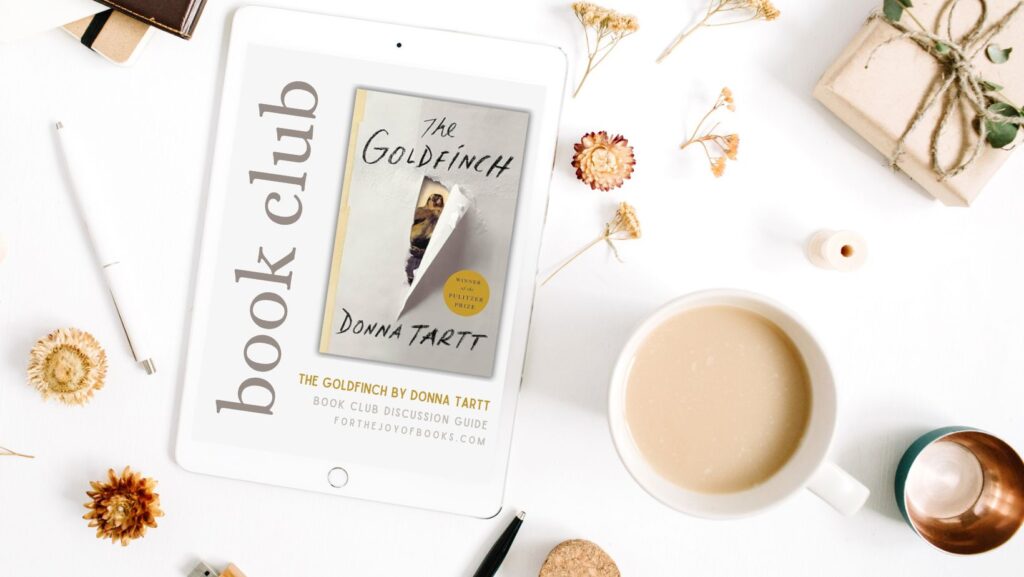
Why Choose The Goldfinch for Your Next Book Club Read?
The Goldfinch is about a 13-year-old boy who survives a terrorist attack in an art museum that kills his mother. His father had left the family months earlier, leaving him at the mercy of well-meaning social workers.
The book follows Theo Decker’s challenging life from a young teenager to a young adult as he navigates his new and challenging life.
This is an amazing story of the survival of a kid who doesn’t always make the right decisions and the people in his life who make it possible.
One potential challenge for this book as a book club pick is that it is long. It is more than 700 pages. One thing that may help those who are intimidated by the length is to listen to the audiobook, which is excellent.
If you are looking for a great read for your book club, I can confidently recommend The Goldfinch by Donna Tartt.
Read my full review of The Goldfinch here.
Free Download
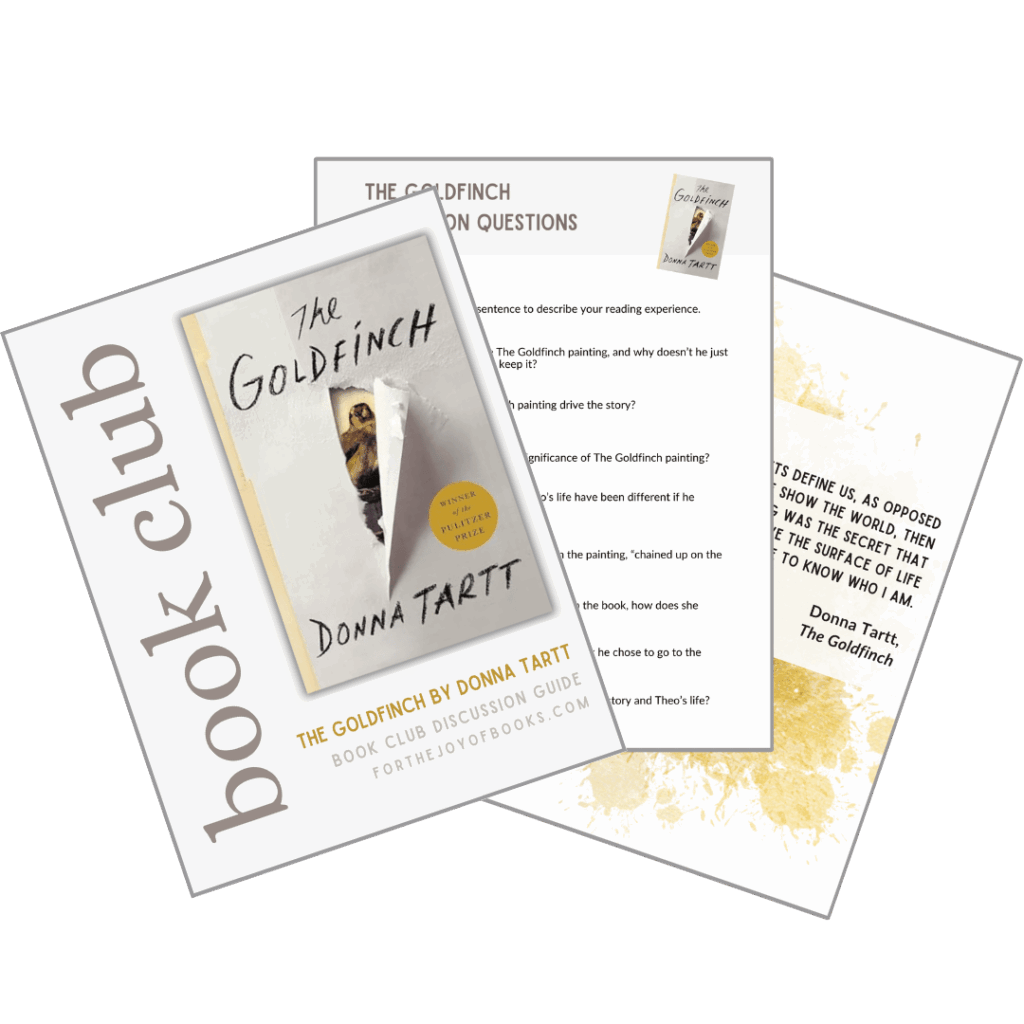
Download the Book Club Discussion Guide!
Find the discussion guide in the free resource library!
The Goldfinch Book Club Discussion Questions
- Write a 10-word sentence to describe your reading experience.
- Why does Theo take The Goldfinch painting, and why doesn’t he just return it? Why did he keep it?
- How does The Goldfinch painting drive the story?
- What is the philosophical significance of The Goldfinch painting?
- How would the story and Theo’s life have been different if he hadn’t taken The Goldfinch?
- In what way is Theo like the bird in the painting, “chained up on the wall there,” as Boris describes it?
- Even though Theo’s mom dies early in the book, how does she continue to play a role in the story?
- After Theo’s mom dies, why do you think he chose to go to the Barbours?
- How does going to the Barbours shape the story and Theo’s life?
- Why did Theo’s dad come back for him? Do you think it was with good intentions?
- How does Theo’s time in Las Vegas affect the rest of the story and his life?
- How does Theo’s relationship with Boris impact his life?
- Why did Boris like Theo’s Dad so much?
- Discuss Theo’s relationship with the following people. Specifically, discuss the influence they had on him — the good, the bad, and the ugly:
- Andy
- Mrs. Barbour
- Mr. Barbour
- Boris
- Hobie
- Pippa
- Kitsey
- Theo’s Mom
- Theo’s Dad
- Xandra
- The dog – Popchick
- Platt
- How do you think the story would have been different if Theo had not run into Mr. Barbour in the park when he returned to New York?
- Why does Theo start doing business the way he does? Was this a necessity, or could it have been avoided?
- When Theo finally goes back to the Barbours, why does he say that being at the Barbours is like returning home?
- Part 4, Chapter 9… Theo says that in some ways, Andy’s death was inevitable. Do you agree or disagree? Why or why not?
- Which event had the most significant negative impact on Theo’s life: the death of his mother or the death of his father? Or was it something else?
- Toward the end of the book, Theo says that Boris reminds him of his Dad. Do you agree or disagree? Why or why not?
- Compare and contrast Theo’s life with Boris’s? Who had it worse?
- In Part 5, Chapter 12, Theo and Hobie have a discussion about whether or not it’s noble to care so much about objects.
- Hobie says, “Where’s the nobility in patching up a bunch of old tables and chairs? Corrosive to the soul, quite possibly.” He then compares it to idolatry, saying, “caring too much for objects can destroy you. Only, if you care for a thing enough, it takes on a life of its own, doesn’t it? And isn’t the whole point of things—beautiful things—that they connect you to some larger beauty? Those first images that crack your heart wide open and you spend the rest of your life chasing, or trying to recapture, in one way or another?”
- With this in mind, at what point does caring for objects become destructive or are beautiful things a connection to “some larger beauty?” Did it become destructive for Theo?
- What did you think of the ending?
- Specifically, what do you think about Theo’s pessimistic thoughts about life: “Life is catastrophe.”
- What do you think about where he stands with the Barbours?
- What do you think about Theo’s life of travel?
- Are we defined by our secrets, as Theo suggests? (Read the quote below for context.)
- “If our secrets define us, as opposed to the face we show the world, then the painting was the secret that raised me above the surface of life and enabled me to know who I am.”
- It’s a Wonderful Life is on while he talks to Boris toward the end. Compare and contrast that movie with this book.
- If you were God, how would you alter the facts for Theo?
- Why did Theo choose “to write these pages”? What do you make of these conclusions he reaches?
- “Whatever teaches us to talk to ourselves is important. . . . the painting has also taught me that we can speak to each other across time, and I feel that I have something very serious and urgent to say to you:
- Life, whatever else it is, is short. That fate is cruel, but maybe not random. That nature, meaning death, always wins, but that doesn’t mean that we have to bow and grovel to it. That maybe even if we’re not always so glad to be here, it’s our task to immerse ourselves anyway — wade straight through it, right through the cesspool, while keeping eyes and hearts open, and in the midst of our dying, as we rise from the organic, and sink back ignominiously into the organic, it is a glory and privilege to love what death doesn’t touch. For if disaster and oblivion have followed this painting down through time, so too has love, insofar as it is immortal, and it is. I have a small, bright, immutable part in that immortality. It exists, and it keeps on existing. And I add my own love to the history of people who have loved beautiful things and looked out for them, and pulled them from the fire and sought them when they are lost and tried to preserve them and save them while passing them along literally from hand to hand, singing out brilliantly from the wreck of time to the next generation of lovers and the next.”
- With this in mind, what would you say is the moral or lesson of this book?
- “Whatever teaches us to talk to ourselves is important. . . . the painting has also taught me that we can speak to each other across time, and I feel that I have something very serious and urgent to say to you:
- What do you think the future looks like for Theo?